An auditor asked me a simple question during a STIG review.
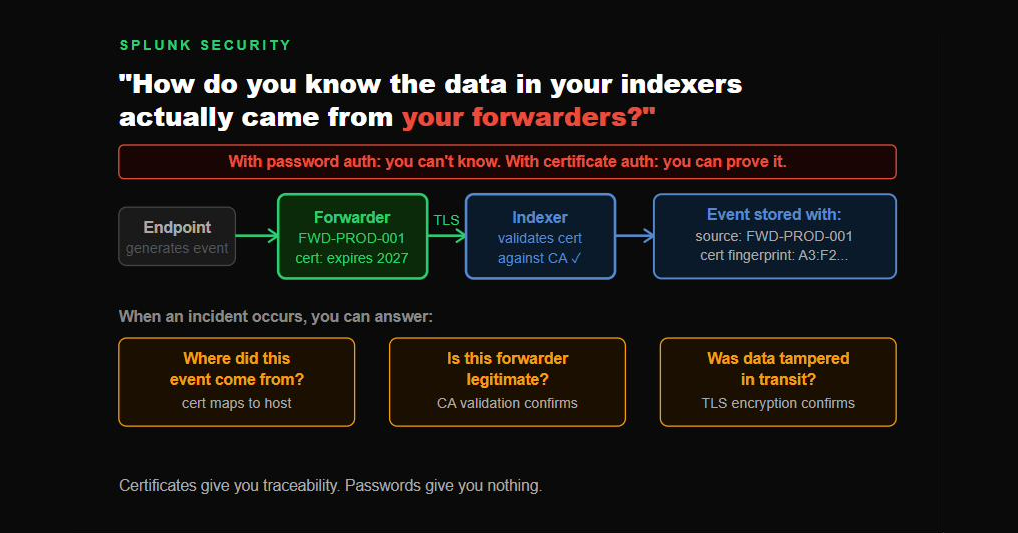
"How do you know the data coming into your Splunk indexers is actually from your forwarders?"
The room went quiet. They were using username and password authentication. Anyone on the network could send data to their indexers.
That question changed how I build every Splunk environment I touch.
The Problem With Password Authentication
Splunk forwarders authenticate to indexers when establishing connections. In many environments, that authentication relies on a shared username and password — or worse, no authentication at all.
The problem is twofold.
First, passwords can be compromised. A credential leaked from one system can be used to inject arbitrary data into your Splunk indexers from any host on the network. Your SIEM is now receiving data from an unauthenticated source. You have no way to know.
Second, passwords don't prove identity. A valid password proves someone knows the password. It doesn't prove the system presenting that password is the forwarder you deployed on that endpoint. Certificate-based authentication proves both.
How Certificate-Based Authentication Works
Every forwarder gets a unique client certificate signed by your internal certificate authority. Every indexer is configured to require and validate that certificate before accepting a connection.
When a forwarder connects to an indexer, it presents its certificate. The indexer validates the certificate against the CA. If validation fails — expired certificate, wrong CA, revoked certificate — the connection is rejected. No data flows.
This means:
- Only your forwarders can send data to your indexers
- Each forwarder has a unique, traceable identity
- A compromised host cannot inject data without a valid certificate
- Certificate expiration forces regular credential rotation automatically
For Federal and DoD environments operating under STIG requirements, this isn't optional. It's a control requirement. But even in commercial environments, it's the only architecture that gives you confidence in the integrity of your data pipeline.
Implementing It in Splunk
The implementation involves four steps:
- Generate your CA and certificate infrastructure — either using your existing PKI or creating a dedicated Splunk CA. Never use self-signed certificates in production. They defeat the purpose.
- Issue client certificates to each forwarder — one certificate per forwarder, signed by your CA. Store the private key securely on the forwarder host.
- Configure indexers to require client certificates — update inputs.conf on each indexer to require SSL and validate client certificates against your CA bundle.
- Configure forwarders to present certificates — update outputs.conf on each forwarder with the certificate path, private key path, and CA bundle.
The configuration itself is straightforward. The discipline is in the certificate lifecycle management — tracking expiration dates, rotating certificates before they expire, and revoking certificates when a host is decommissioned.
The Operational Payoff
Beyond the security benefit, certificate-based authentication gives you something password authentication never can: a complete, auditable record of which forwarder sent which data.
When an incident occurs and you need to trace data provenance — where did this event come from, is this forwarder legitimate, was this data tampered with in transit — certificates give you the answer. Passwords give you nothing.
In environments where data integrity is a compliance requirement, that traceability is the difference between passing an audit and explaining a finding.
If you're implementing certificate-based authentication as part of your STIG compliance posture, the STIG Compliance App for Splunk helps you track and report that posture directly in Splunk — no spreadsheets required. It's free on Splunkbase: splunkbase.splunk.com/app/8486
Enforce security for data in transit. Know that what's in your indexers came from where you think it came from.
Have you implemented certificate-based authentication in your Splunk environment? What was the biggest challenge? Drop it in the comments.
I publish a new Splunk article every week. Follow me to catch the next one.
═══════════════════════════════════════════════════════════════════════════════
───────────────────────────────────────────────────────────────────────────────
───────────────────────────────────────────────────────────────────────────────