A new CVE drops. Critical severity. It affects a popular open-source library your development teams probably use.
How long does it take your team to answer one question: "Are we affected?"
If the answer is measured in hours or days, you have a visibility problem, not a patching problem.
The Log4Shell Lesson Nobody Learned
December 2021. CVE-2021-44228. Log4Shell. It was critical remote code execution in Apache Log4j, a logging library embedded in virtually every Java application on the planet.
The vulnerability was publicly disclosed on a Friday. By Monday morning, every security team in the world was asking the same question: "Where is Log4j in our environment?"
Organizations with software bill of materials (SBOM) data answered in minutes. They searched their component inventory, identified every application using Log4j, prioritized by exposure, and started patching.
Organizations without SBOM data spent days, sometimes weeks, manually inventorying applications, contacting development teams, scanning build artifacts, and still missing instances embedded three layers deep in transitive dependencies.
The vulnerability was the same. The detection was the same. The response time was determined entirely by whether you could search your software components.
What Component Search Does
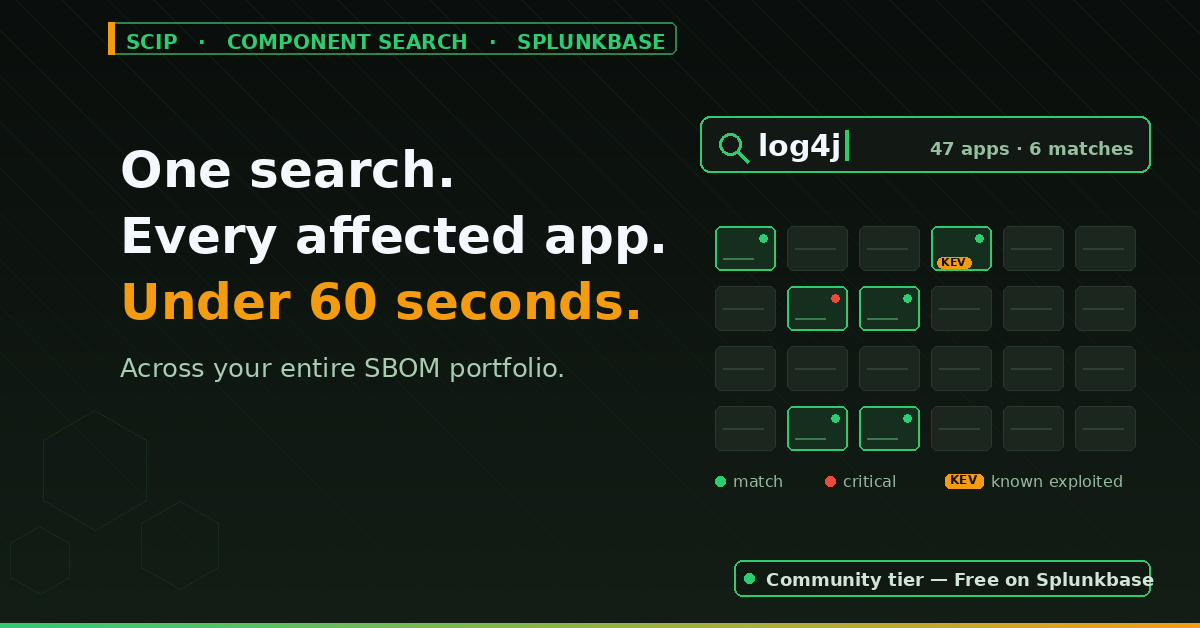
The Component Search dashboard in SCIP, the Splunk app that I built for supply chain risk, answers the "are we affected" question in under 60 seconds.
When a new CVE drops, you open Component Search. You type the component name, log4j, openssl, spring-framework, whatever the advisory names. SCIP searches across every SBOM in your environment and returns:
- Every application that includes that component
- The exact version deployed in each application
- The CVE count associated with that version
- The severity distribution, critical, high, medium, low
- Whether any associated CVEs appear on CISA's Known Exploited Vulnerabilities (KEV) list
One search. Every affected system. Under 60 seconds.
This is not a scan. There is nothing to run, nothing to schedule, nothing to wait for. SCIP maintains a continuously updated component inventory from your SBOM data. The search is instant because the data is already indexed.
Cross-SBOM Visibility
Most organizations generate SBOMs per application. Application A has its SBOM. Application B has its SBOM. When a CVE drops, someone has to search each one individually, or more commonly, nobody searches any of them because the process is too manual.
Component Search operates across your entire SBOM portfolio simultaneously. If you have 50 applications generating SBOMs into Splunk through SCIP, one search covers all 50. You see every instance of a vulnerable component regardless of which application it belongs to.
This is the difference between "we checked Application A and it's clean" and "we checked everything and here's the complete exposure picture."
The Version Problem
Knowing you have Log4j is not enough. You need to know which version.
Log4j 2.0 through 2.14.1: vulnerable to Log4Shell.
Log4j 2.15.0: partially patched.
Log4j 2.17.1+: fully remediated.
Log4j 1.x: different vulnerability profile entirely.
Component Search shows the exact version deployed in each application. Not "we use Log4j" but "Application A uses Log4j 2.14.1, Application B uses Log4j 2.17.1, Application C uses Log4j 1.2.17." Three different risk profiles. Three different remediation priorities.
The KEV Correlation
Not all CVEs are created equal. A CVE with a CVSS score of 9.8 sounds urgent, but if there's no known exploit in the wild, the operational risk is different from a CVE with a CVSS score of 7.2 that CISA has confirmed is being actively exploited.
Component Search flags components with CVEs that appear on CISA's Known Exploited Vulnerabilities catalog. This is the "drop everything and patch" indicator. When your search results show a KEV match, that component moves to the top of your remediation queue regardless of CVSS score.
Building This Into Your Workflow
The highest-value use of Component Search is not reactive, it's proactive.
Set up a recurring process: when CISA publishes a new KEV entry, search for that component in SCIP. This takes less than a minute. If you get zero results, you're not affected. If you get results, you know exactly where and can act immediately.
The same applies to vendor security advisories. When your software vendor publishes a security bulletin naming specific components, search for them. Instant exposure assessment.
Component Search is part of SCIP. Install from Splunkbase, ingest your SBOMs, and start searching: splunkbase.splunk.com/app/8814
The next time a critical CVE drops, will your team spend 60 seconds confirming exposure, or 60 hours hunting for it?
Drop your current CVE response time in the comments. I'd like to understand where most teams are.