Your ATO package is due. The ISSO needs supply chain risk documentation mapped to SA-10, SA-11, and SI-2. Your development team has SBOMs somewhere, maybe.
The last time someone tried to map software component data to RMF controls, it took two weeks and a contractor.
This is the federal supply chain compliance problem. Not a lack of data, a lack of integration between the systems that generate the data and the frameworks that require it.
The RMF Supply Chain Controls
NIST SP 800-53 Rev 5 includes specific controls for software supply chain risk:
CM-8 (System Component Inventory): requires a current, accurate inventory of the software components in your systems, including third-party and open-source libraries.
RA-5 (Vulnerability Monitoring and Scanning): requires scanning those components for known vulnerabilities and analyzing the results, including composition analysis of dependencies.
SI-2 (Flaw Remediation): requires timely identification and remediation of software flaws, including vulnerabilities in third-party components.
The SR family (SR-2, SR-3, SR-4): requires a supply chain risk management plan, defined supply chain controls and processes, and provenance for the components you depend on.
For federal systems pursuing an Authority to Operate, these controls require evidence. Not a policy document saying "we manage software components." Actual evidence, inventories, scan results, remediation timelines, and continuous monitoring data.
Why Federal Teams Struggle With This
Federal IT environments have unique constraints that make supply chain compliance harder than commercial equivalents:
Air-gapped networks. Many federal systems operate in disconnected or partially connected environments. Cloud-based SCA tools that require internet connectivity don't work here. The compliance tooling must operate on-premises, inside the security boundary.
Multiple accreditation boundaries. A single agency may operate dozens of systems, each with its own ATO package. Supply chain evidence must be generated per-system, not as a single enterprise report.
Strict evidence formatting. AOs and ISSOs expect evidence in specific formats. A Splunk dashboard is useful for monitoring but doesn't satisfy the documentation requirements. Exportable reports that map to specific control numbers are what the ATO package needs.
FedRAMP inheritance. Systems built on FedRAMP-authorized cloud infrastructure inherit certain controls from the CSP, but software supply chain controls are almost never inheritable. They apply to the application layer, which is the agency's responsibility regardless of hosting model.
What SCIP Provides for Federal Environments
SCIP, the Splunk app that I built for supply chain risk, is designed for these constraints.
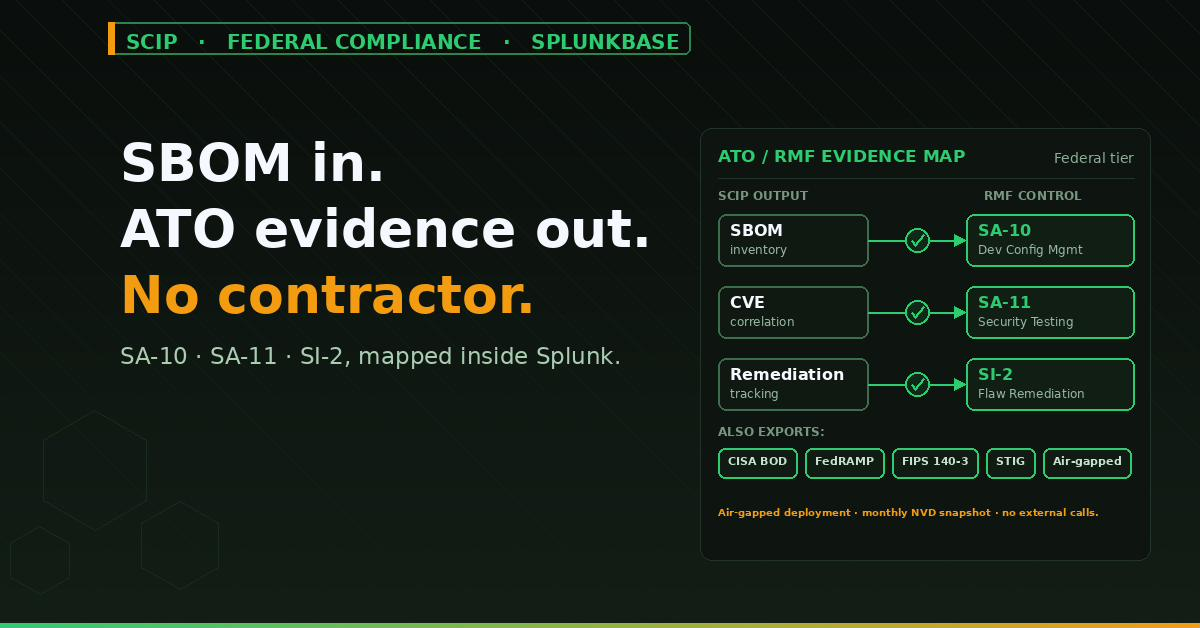
ATO/RMF Documentation Templates. Pre-built evidence templates that map directly to SCIP's data outputs. Your SBOM inventory maps to SA-10 (Developer Configuration Management). Your CVE correlation results map to SA-11 (Developer Security Testing). Your remediation tracking maps to SI-2 (Flaw Remediation). The templates reference the specific Splunk searches and dashboards that produce the evidence.
CISA BOD Risk-Tier Exports. SCIP correlates your components against CISA's Known Exploited Vulnerabilities catalog and produces a BOD 26-04 risk-tier classification, the directive that succeeds BOD 22-01, computing a risk tier and remediation deadline for each KEV-matched vulnerability. No manual cross-referencing between your vulnerability scanner output and the KEV catalog.
FedRAMP Evidence Generation. For systems pursuing FedRAMP authorization, SCIP produces evidence artifacts that map to FedRAMP's control assessment procedures. The same SBOM and CVE data that supports your RMF package supports your FedRAMP assessment.
Air-Gapped Deployment. SCIP operates entirely within your Splunk environment. No external API calls required for core functionality. NVD vulnerability data is delivered as a monthly snapshot that can be transferred across air gaps via approved media. SBOM data is ingested locally via HEC or file monitor. The entire platform runs inside your security boundary.
FIPS Compliance Statement. SCIP includes a FIPS 140-2/3 compliance statement documenting the app's cryptographic posture. SCIP itself does not perform cryptographic operations, it relies on the underlying Splunk platform's FIPS-validated modules. The statement documents this inheritance chain for your security documentation.
STIG Impact Assessment. A pre-built assessment mapping SCIP's deployment against applicable Splunk STIG findings. Your ISSO can review the impact assessment as part of the deployment approval process rather than conducting an independent STIG review of the app.
CI/CD Pipeline Integration
Federal development teams operating DevSecOps pipelines can automate SBOM delivery to SCIP. Pre-built pipeline templates for Jenkins, GitLab CI, and GitHub Actions send SBOM data to Splunk via HEC as part of the build process.
Every build generates an SBOM. The SBOM is automatically ingested into SCIP. CVE correlation happens immediately. By the time the build completes, the supply chain risk profile is available in your Splunk dashboards.
For air-gapped environments where CI/CD pipelines don't have network access to Splunk, the templates include an offline mode that writes SBOM files to a staging directory for manual transfer.
The .conf2026 Conversation
If you're going to be at .conf2026 this September, I'd like to talk about how SCIP fits into your federal compliance workflow. Whether you're wrestling with RMF documentation, FedRAMP evidence, or CISA BOD reporting, the problem is the same: mapping software supply chain data to the controls and reporting formats your accreditation process requires.
SCIP's federal capabilities include air-gapped deployment support, ATO/RMF documentation templates, CISA BOD exports, FedRAMP evidence generation, FIPS compliance documentation, and STIG impact assessment. Install from Splunkbase: splunkbase.splunk.com/app/8814
How much time does your team spend on supply chain evidence for ATO packages? Drop your answer in the comments, I'm trying to quantify the scope of this problem across federal organizations.