Most teams treat the license column of an SBOM as paperwork, a field the tool fills in, that nobody reads.
Two things are changing that. The EU Cyber Resilience Act puts security-and-support obligations on the products you place on the market, and CISA's finalized 2026 Minimum Elements for an SBOM made License a required baseline field, alongside component hash, tool name, and generation context, closing out a public-comment process that ran through late 2025.
License risk was always there. What's new is that it's becoming evidence someone can ask you for.
Why License Is a Security Question, Not Just a Legal One
It's easy to file licensing under "legal's problem." But license terms can directly constrain whether you can keep a piece of software secure.
A copyleft license like GPL or AGPL carries obligations that, if triggered, change how you're allowed to distribute or modify the software. A component whose license is unknown is a component you can't fully reason about, you don't know what you're permitted to do with it when you need to patch, fork, or redistribute. CISA's own rationale for adding the field is that license conditions can affect an agency's ability to rely on software, and a producer's ability to support it.
In other words: an inadequately licensed dependency is a risk to your ability to respond, not just a compliance line item.
The Exposure Most Teams Can't See
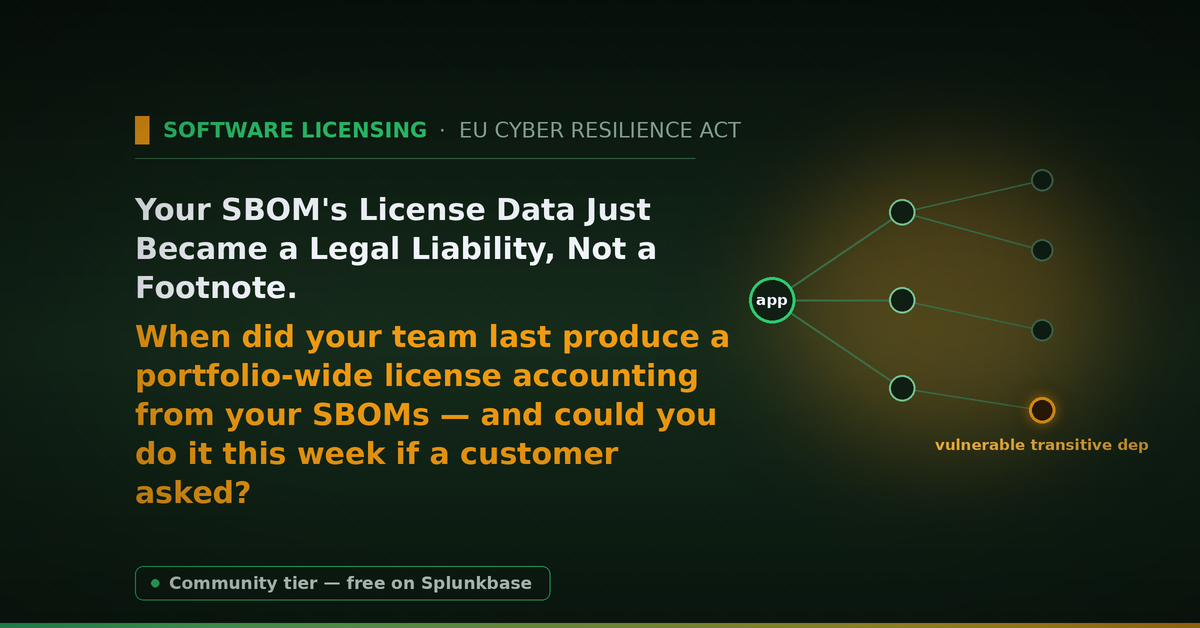
The hard cases aren't the obvious ones. They're the AGPL dependency pulled in transitively that nobody chose deliberately. The component that relicensed between the version you adopted and the version you're shipping. The library with no declared license at all, which your tooling silently passed through.
If your SBOMs are scattered per application in a build system, none of this is visible as a portfolio. You find out when a customer's procurement team, or an acquirer's due-diligence review, asks for a license accounting you can't produce on demand.
Making License Risk Searchable
SCIP, the Supply Chain and AI Threat Intelligence Platform, reads the license data already in your CycloneDX and SPDX SBOMs and surfaces it across your whole portfolio in Splunk. It classifies the license types it finds and flags the categories that carry obligations or that are missing entirely, so "show me every product carrying a copyleft dependency" or "show me components with no declared license" is a search, not a quarter-long audit.
That turns the license column from a field nobody reads into the thing it's quietly becoming: evidence. When the CRA's expectations mature and procurement teams ask harder questions, the accounting already exists.
SCIP reports the license information present in your SBOMs and organizes it for risk decisions. It is not legal advice, and it doesn't adjudicate whether an obligation is triggered, that judgment stays with your counsel. What it removes is the "we have no idea what's in there" problem that makes the legal question unanswerable in the first place.
See What's Actually in Your License Column
License visibility is part of SCIP on Splunkbase. Install it, point it at your SBOMs, and find out what your dependencies' licenses say: splunkbase.splunk.com/app/8814
The license field stopped being a footnote. The teams that can produce a clean license accounting on request will treat that as routine. The ones that can't will treat it as a fire drill.
When did your team last produce a portfolio-wide license accounting from your SBOMs, and could you do it this week if a customer asked? I'd genuinely like to know.
P.S. I'm at .conf2026 in Denver this week, presenting SEC1049, a practical MITRE ATLAS implementation with ten deployable SPL detection rules for LLM threats. If you're here too, drop me a message and let's connect.